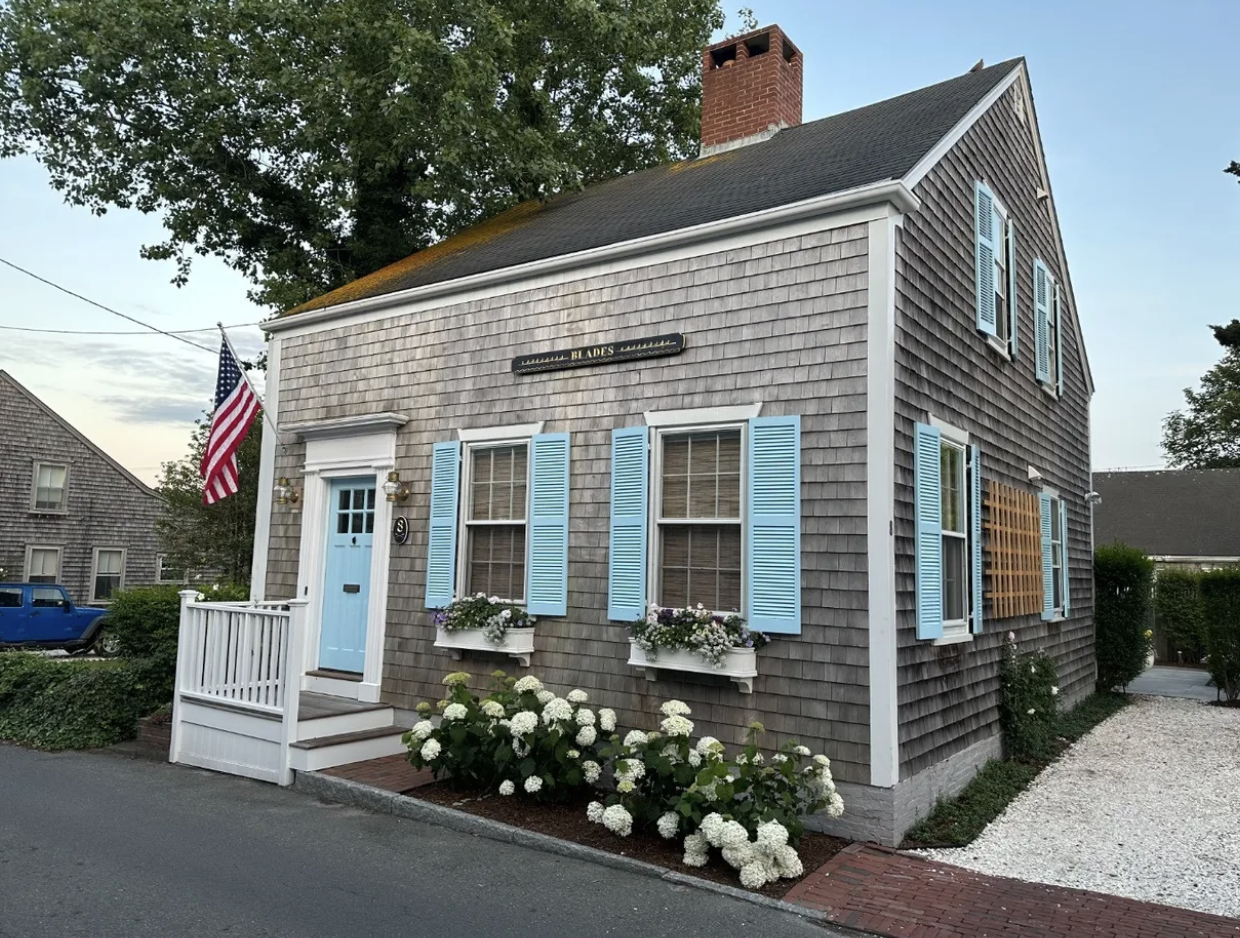
Nantucket, MA is one municipality across a 47-square-mile island with uniform Historic District Commission architectural review, a $2.5M entry floor, and the strongest single brand identity in Northeast coastal luxury. Martha's Vineyard, MA is six distinct towns across 100 square miles with town-level architectural review, a $600K entry floor, and materially more community diversity across the island. Both islands charge a 2 percent Land Bank fee to the buyer at closing. Buyers who value concentration of brand identity and uniform preservation choose Nantucket. Buyers who value diverse community character and broader price accessibility choose Martha's Vineyard. Neither island is objectively better; they serve different family profiles.
Two Massachusetts Islands, Two Fundamentally Different Products
Nantucket and Martha's Vineyard are frequently discussed together as the two Massachusetts island markets serving Northeast coastal luxury buyers. That grouping is geographically accurate but structurally misleading. The two islands deliver fundamentally different products at every meaningful metric except for the shared 2 percent Land Bank fee that both charge to the buyer at closing.
Nantucket is 47 square miles of island under a single municipal government, with island-wide Historic District Commission review, a concentrated commercial center, one dominant year-round community, and the tightest brand identity in the Northeast coastal luxury category. The physical scale, the governance structure, and the cultural character all work in the same direction: concentration.
Martha's Vineyard is 100 square miles across six separate towns (Aquinnah, Chilmark, Edgartown, Oak Bluffs, Tisbury, West Tisbury), each with its own municipal government, its own zoning, its own STR ordinance, and its own community character. Chilmark's rural agricultural landscape has nothing structurally in common with Oak Bluffs's Victorian summer community, and neither is much like Edgartown's formal old-money village or Tisbury's commercial ferry landing. The physical scale, the governance structure, and the cultural character all work in the same direction: diversity.
Buyers who understand this structural difference make substantially better acquisition decisions than buyers who treat the two islands as interchangeable. Below is the honest 2026 side-by-side.
The Structural Side-by-Side
| Factor | Nantucket, MA | Martha's Vineyard, MA |
|---|---|---|
| Island size | 47 square miles | 100 square miles |
| Number of municipalities | 1 (Town of Nantucket) | 6 (Aquinnah, Chilmark, Edgartown, Oak Bluffs, Tisbury, West Tisbury) |
| Year-round population | ~14,000 | ~20,000 (across 6 towns) |
| Distance from mainland | ~30 miles offshore | ~7 miles offshore |
| Ferry from mainland | Hyannis, MA (~2 hr 15 min vehicle; ~1 hr passenger) | Woods Hole, MA (~45 min) |
| Entry price (meaningful inventory) | ~$2.5M | ~$600K |
| Mid-market range | $4M-$8M (in-town, mid-island) | $1.5M-$5M (varies by town) |
| Top of active market | $15M+ (Cliff, Monomoy, Sconset) | $20M+ (Chilmark, Edgartown oceanfront) |
| Land Bank fee | 2% buyer-paid at closing | 2% buyer-paid at closing |
| Architectural regulation | HDC reviews virtually all exterior work island-wide | Town-level review; varies by municipality |
| Community structure | One concentrated community | Six distinct town cultures |
| Brand identity | Strongest single identity in Northeast coastal luxury | Diverse across six towns; Chilmark and Edgartown lead |
Sources: Town of Nantucket; Martha's Vineyard Commission; Nantucket Islands Land Bank; Martha's Vineyard Land Bank; recent Realtor.com and MLS inventory data. Verified July 2026.
The Ferry Access Difference That Matters More Than Buyers Expect
Both islands require ferry access, but the practical differences are meaningful. The Woods Hole to Vineyard Haven or Oak Bluffs vehicle ferry runs approximately 45 minutes. The Hyannis to Nantucket vehicle ferry runs approximately 2 hours 15 minutes. That 90-minute differential compounds materially across a hold period. A Martha's Vineyard family driving from Boston makes the ferry crossing feel like a natural extension of the drive. A Nantucket family driving from Boston commits to a genuine crossing that adds substantial travel time in both directions.
For families with dispersed extended relatives, the shorter Martha's Vineyard crossing meaningfully widens the practical guest pool. Grandparents can more easily make weekend visits. Adult children with young families face less coordination burden. For buyers whose acquisition case is heavily oriented around active use across multiple generations and seasons, the ferry-crossing differential is a real quality-of-life factor.
The Six Towns of Martha's Vineyard
The single largest conceptual difference between the two islands is that Martha's Vineyard is not one place; it is six. Understanding the six towns is the entry point to serious Martha's Vineyard buyer evaluation.
| MV Town | Character | Typical Price Range |
|---|---|---|
| Edgartown | Formal old-money village, walkable, historic architecture | $1.5M-$20M+ |
| Chilmark | Rural, agricultural, preservation-focused, low density | $2M-$15M+ |
| West Tisbury | Rural, agricultural, quieter than Chilmark | $1M-$8M+ |
| Aquinnah (Gay Head) | Tribal governance, dramatic clay cliffs, most remote | $1.5M-$10M+ |
| Oak Bluffs | Victorian community, ferry landing, colorful gingerbread cottages | $600K-$5M+ |
| Tisbury (Vineyard Haven) | Commercial ferry landing, working town, year-round community | $700K-$4M+ |
Typical 2026 price bands based on recent Realtor.com and MLS inventory. Actual pricing depends on specific parcel characteristics, waterfront access, and current market conditions.
Nantucket: One Island, One Concentrated Identity
Nantucket delivers something Martha's Vineyard structurally cannot: a single unified island identity. The town of Nantucket governs the entire island. The HDC reviews virtually every exterior architectural feature on every property island-wide. The commercial center, the primary residential neighborhoods, and the trophy waterfront corridors all sit within roughly a 7-mile driving radius of Nantucket Town. Sconset at the east end and Madaket at the west end offer distinct village and beach identities, but the underlying regulatory and community framework is unified.
For buyers who value concentration, this is genuinely attractive. The Nantucket brand identity does not fragment. The architectural character is preserved uniformly. The year-round community is concentrated enough to have real continuity but small enough to feel intimate. Buyers who acquire on Nantucket become part of a specific and coherent island community rather than choosing among six different community options.
What the Same Budget Buys on Each Island
| Budget | What it buys on Nantucket, MA | What it buys on Martha's Vineyard, MA |
|---|---|---|
| $1M | Below entry; not viable | Meaningful Oak Bluffs or Tisbury property |
| $2M | Modest entry tier | Meaningful Edgartown or West Tisbury |
| $3M | Mid-island or Sconset entry | Strong Edgartown or Chilmark position |
| $5M | Entry to mid-tier island | Trophy Edgartown or Chilmark inventory |
| $8M | Meaningful Cliff or Brant Point | Approaching top of Chilmark market |
| $10M+ | Trophy tier; supply-constrained | Top of Chilmark and Edgartown oceanfront |
Illustrative buying power at each price tier based on typical 2026 inventory patterns. Actual property characteristics vary within each budget across both islands.
The honest cost math: Below $3M, Martha's Vineyard delivers meaningfully more property than Nantucket at every tier. At $5M, both islands deliver meaningful prestige inventory; the choice becomes about which community character fits the family better. Above $10M, the two islands converge on trophy tier at similar quality levels though with distinctly different products. The buyer's actual budget substantially determines whether the comparison is even close. A family with $1M-$3M in acquisition capital is effectively deciding whether to be on Martha's Vineyard or not on either island; Nantucket is not really in that price band.
Regulatory Environment: Uniform vs. Diverse
The Nantucket Historic District Commission reviews virtually all exterior architectural work on every property on the island. The commission has 60 days from a complete application to act. Complex projects typically take 3 to 6 months in HDC review; new construction 6 to 12 months. Two specific zoning overlays (Residential Old Historic and Sconset Old Historic) impose additional constraints including pool prohibitions.
Martha's Vineyard's regulatory environment is materially different. Each of the six towns has its own historic district commission and its own zoning code. Edgartown historic review is intensive; Chilmark's is oriented more around lot size and preservation than architectural detail. West Tisbury and Aquinnah operate under distinct frameworks. Buyers whose acquisition case includes renovation or new construction on Martha's Vineyard need to work off the specific town's rules; the island does not have a unified review structure equivalent to Nantucket's HDC.
For buyers who want architectural certainty and consistent preservation across the island, Nantucket's uniform framework is genuinely attractive. For buyers who want more flexibility in some towns and can accept more variation across the island, Martha's Vineyard's town-level framework offers more diverse options.
Community Continuity and Family Use Patterns
Martha's Vineyard has a larger year-round population (~20,000 across six towns) than Nantucket (~14,000). The year-round community infrastructure on Martha's Vineyard is materially deeper, with meaningful municipal services, more school options across the six towns, and stronger year-round commercial infrastructure. For families with school-aged children whose acquisition case includes any meaningful year-round or shoulder-season use, this depth matters.
Nantucket's year-round community is smaller but more concentrated. Everyone who lives on Nantucket in the winter knows everyone else who lives on Nantucket in the winter. That intimacy is a genuine feature for buyers who value it, and a limitation for buyers whose family use pattern requires more anonymity or more diverse community options.
The community-fit question buyers routinely under-weight: Both islands can be beautifully suited to a specific family and painfully wrong for another. The Nantucket concentration is not universally attractive; some families feel the intensity of the single community as isolating rather than intimate. The Martha's Vineyard diversity is not universally attractive; some families feel the six-town structure as fragmenting rather than diversifying. The right approach is to spend real time on both islands, in the specific towns and neighborhoods you would actually buy in, and to honestly assess how your family responds to the specific community texture. This is not something to sort out after closing.
Long-Term Appreciation: The Historical Record
Nantucket has historically delivered stronger absolute appreciation than Martha's Vineyard, driven by structural supply constraint on a single 47-square-mile island with a single governance structure. The Land Bank has permanently conserved thousands of acres. The HDC preserves architectural character uniformly. The result is one of the tightest supply-constrained markets in American residential real estate.
Martha's Vineyard has delivered steady appreciation with more distributional variation across the six towns. Chilmark and Edgartown have consistently led. Oak Bluffs and Tisbury have delivered meaningful accessibility gains. The overall island market has appreciated well over four decades, though not with the same compressed intensity as Nantucket's single-market dynamic.
For buyers whose intergenerational strategy prioritizes maximum single-market appreciation and brand identity, Nantucket has been the historical winner. For buyers whose strategy allows for broader distribution of outcomes across a more diverse market, Martha's Vineyard has delivered strong results with materially lower entry pricing and more community optionality.
Which Family Belongs on Which Island
Nantucket, MA is the better fit for families who:
- Have $2.5M+ in acquisition capital and want the strongest single brand identity in Northeast coastal luxury
- Value uniform architectural preservation and HDC-consistent island-wide character
- Prefer a single concentrated year-round community over diverse town options
- Prioritize maximum supply-constrained appreciation as part of the intergenerational strategy
- Are comfortable with the 2 hour 15 minute vehicle ferry from Hyannis and can absorb the logistical friction
- Value the specific Nantucket identity and see themselves as long-term stewards within that community
Martha's Vineyard, MA is the better fit for families who:
- Have $600K to $10M in acquisition capital and want more accessible entry-level or more property at every tier below $5M
- Value the diversity of six distinct town cultures and the ability to choose among them
- Prefer stronger year-round community depth and broader school and municipal service infrastructure
- Benefit from the shorter 45-minute Woods Hole ferry crossing for more frequent mainland travel
- Want flexibility in architectural approach across the six different town frameworks
- Value community diversity and mixed year-round populations over concentrated summer-community intensity
What Buyers Must Verify Before Making an Offer
- Confirm which municipality (MV) or district (Nantucket) applies to the specific parcel: On Nantucket verify HDC zoning designation (ROH, SOH, other). On Martha's Vineyard verify which of the six towns and any town-level historic district or preservation designation.
- Model the 2 percent Land Bank fee explicitly: Both islands charge it to the buyer at closing. On a $3M purchase this is $60,000 out of pocket at closing on either island.
- Review prior regulatory file history: Prior HDC or town-level applications, approvals, denials, and any active conditions transfer with the property.
- Engage local-experienced architect for feasibility on any project-dependent purchase: Islands each reward local relationships and understanding of the specific regulatory culture.
- Verify ferry logistics against actual family use patterns: Both islands require realistic ferry planning; the 90-minute crossing differential matters for high-frequency mainland travel families.
- Understand town-level tax rates on Martha's Vineyard: Rates vary by town. Nantucket rates are uniform island-wide.
- Confirm flood zone and coastal exposure: Applies to waterfront and near-water positions on both islands.
- Verify STR ordinance if rental income is part of the acquisition case: Nantucket has island-wide rules plus state framework. Martha's Vineyard rules vary by town on top of state framework.
The bottom line for prestige island buyers: Neither island is objectively better. They serve different family profiles at different price tiers with different community textures. The buyers who acquire well on either island are the ones who honestly match their family's actual use pattern, budget, and community preferences to the specific island's structural features. The buyers who acquire poorly typically chased assumed brand prestige without evaluating whether the underlying substance actually fits their family. The sophisticated approach is to spend real time on both islands before deciding, and to talk with buyers who have owned on each about the actual multigenerational experience.
Frequently Asked Questions
Is Nantucket or Martha's Vineyard better for a prestige buyer in 2026?
Neither island is objectively better. Nantucket, MA is one municipality across 47 square miles with uniform HDC review, a $2.5M entry floor, and the strongest single brand identity in Northeast coastal luxury. Martha's Vineyard, MA is six distinct towns across 100 square miles with town-level review, a $600K entry floor, and materially more community diversity. Buyers who value concentration and uniform preservation choose Nantucket. Buyers who value diverse community character and broader price accessibility choose Martha's Vineyard.
How much cheaper is Martha's Vineyard than Nantucket?
Martha's Vineyard, MA has meaningful residential inventory starting around $600K in Oak Bluffs and parts of Tisbury. Nantucket, MA has a practical entry floor of approximately $2.5M. At the entry tier, Martha's Vineyard is dramatically more accessible. At the trophy tier the two islands converge more closely. A $5M budget in Chilmark or Edgartown reaches significantly more property than $5M on Nantucket, though Nantucket delivers different value through brand identity and architectural consistency at that price point.
How do you get to Nantucket and Martha's Vineyard?
Nantucket, MA is accessed by ferry from Hyannis, MA (Steamship Authority vehicle ferry approximately 2 hours 15 minutes; high-speed passenger ferry approximately 1 hour) or by air via Nantucket Memorial Airport. Martha's Vineyard, MA is accessed by ferry from Woods Hole, MA (Steamship Authority vehicle ferry approximately 45 minutes) or by air via Martha's Vineyard Airport. Martha's Vineyard's shorter crossing is a meaningful practical advantage for high-frequency mainland-travel families.
Which island has better community for families?
Martha's Vineyard, MA typically offers stronger year-round community infrastructure. The island has approximately 20,000 year-round residents across six towns with meaningful municipal services, schools, and community continuity. Nantucket, MA has approximately 14,000 year-round residents concentrated in one municipality. Families who value active year-round engagement, broader school options, and diverse town character typically fit Martha's Vineyard. Families who value single-community intensity and concentration typically fit Nantucket.
Which Massachusetts island has better long-term appreciation?
Nantucket, MA has historically delivered stronger absolute appreciation than Martha's Vineyard, MA, driven by structural supply constraint on a single 47-square-mile island with uniform HDC preservation and the strongest concentrated brand identity in Northeast coastal luxury. Martha's Vineyard has delivered steady appreciation with more distribution across six towns, with Chilmark and Edgartown leading. For maximum single-market appreciation, Nantucket has been the historical winner. For diversified appreciation with broader options, Martha's Vineyard has delivered strong outcomes.
Evaluating specific Nantucket or Martha's Vineyard acquisition scenarios and want an independent read on which island actually fits your family, budget, and long-term plans, including current inventory, realistic access to off-market opportunities in specific towns or neighborhoods, and how the community texture matches your actual family use pattern? I work with vetted local buyer's agents on both islands and can connect you with representation that understands the specific market dynamics before you commit capital.
Submit a Private InquiryOr reach Peter directly: